On 23 October 2026, the TanStack team officially published TanStack AI 1.0, marking the stable release of their open-source TypeScript AI toolkit co-authored by Alem Tuzlak, Jack Herrington, Tom Beckenham, and Tanner Linsley.
For the past three years, the TypeScript AI ecosystem has been largely defined by the Vercel AI SDK (ai), which established the de facto patterns for streaming language model outputs, handling structured object generation, and connecting AI models to modern web frameworks.
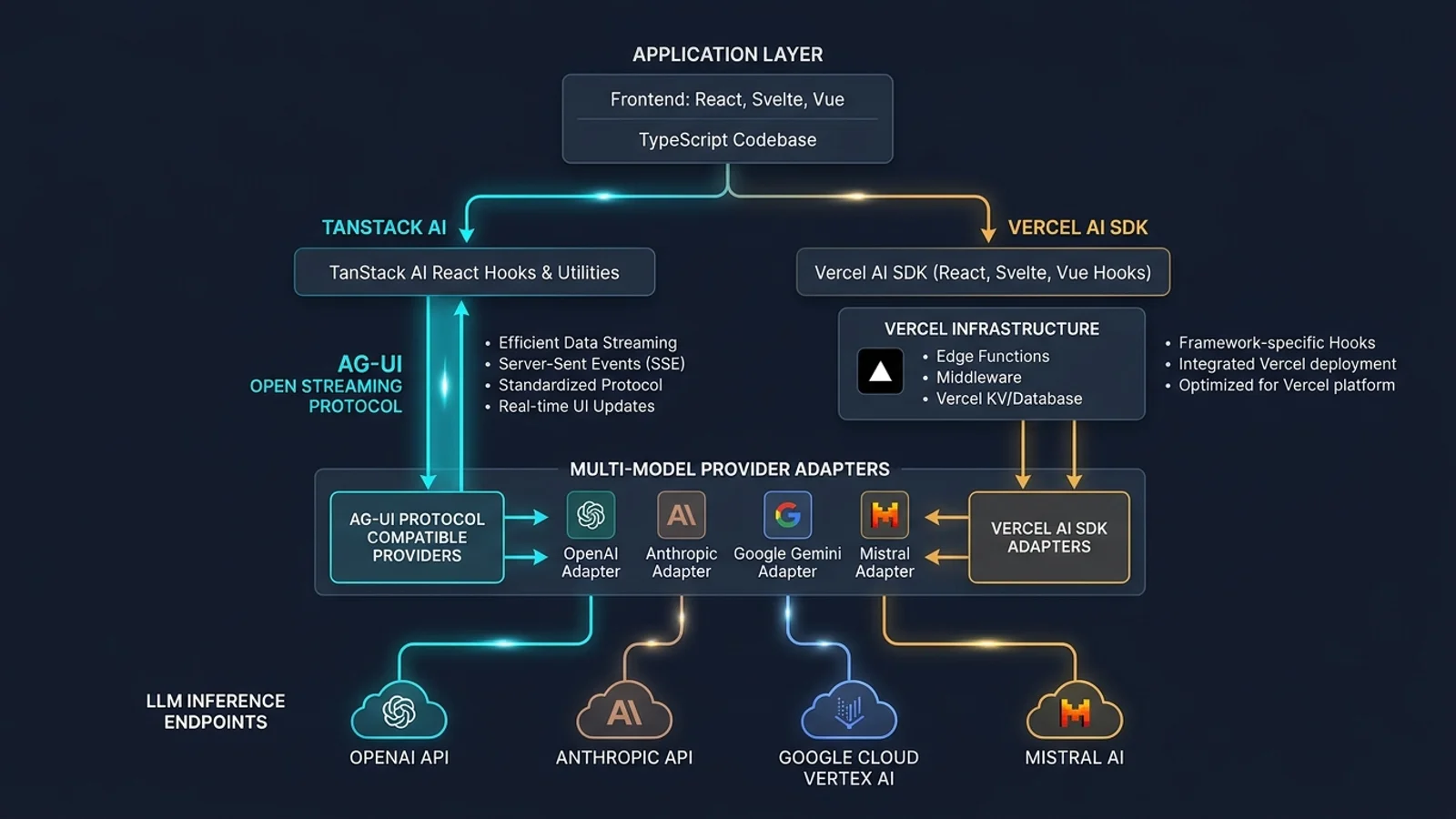
With TanStack AI reaching 1.0, developers now face an authentic architectural choice. Rather than acting as a clone, TanStack AI introduces distinct architectural decisions: native adoption of the open AG-UI (Agent-User Interface) wire protocol, granular per-model TypeScript type safety, isomorphic tool calling that runs seamlessly on both client and server, and strict neutrality across hosting platforms and UI frameworks.
This guide provides an evidence-based comparison of TanStack AI 1.0 vs Vercel AI SDK. We examine what changed in the 1.0 release, analyze their architectural differences across ten key dimensions, walk through a working implementation, detail breaking changes from 0.x, and provide a decision matrix to help you choose the right stack for your next project.
@ai-sdk/react.---
1. What Changed in TanStack AI 1.0?
When TanStack AI first appeared in late 2025 as an alpha, it was a lightweight chat() abstraction with four basic provider adapters. Over ten months of continuous development—spanning 140 contributors, an architecture freeze in the August 2026 Release Candidate, and extensive end-to-end fixture testing—the toolkit has expanded into a production-grade infrastructure layer.
┌─────────────────────────────────────────────────────────────────────────────────────────┐
│                                TANSTACK AI 1.0 ARCHITECTURE                             │
├──────────────────────┬────────────────────────────┬─────────────────────────────────────┤
│ UI & RUNTIMES        │ CORE ORCHESTRATION LAYER   │ PROVIDER ADAPTERS                   │
├──────────────────────┼────────────────────────────┼─────────────────────────────────────┤
│ • React              │ • chat() Streaming Engine  │ • 23 Native Adapters:               │
│ • Vue                │ • AG-UI Open Wire Protocol │   OpenAI, Anthropic, Gemini,        │
│ • Solid              │ • Per-Model Type Narrowing │   Bedrock, Mistral, Grok, Ollama    │
│ • Svelte             │ • Isomorphic Tools (.client│ • Gateway Integrations:             │
│ • Angular            │   and .server)             │   Cloudflare AI, Lovable, Vercel GW │
│ • Vanilla JS / Node  │ • Memory & Compaction      │ • Universal openaiCompatible        │
└──────────────────────┴────────────────────────────┴─────────────────────────────────────┘
The 1.0 Stability Commitment
The 1.0 release formalizes a clear line between stable and experimental surfaces:
- Stable Core APIs (Version 1.0): The core packages (
@tanstack/ai, framework packages like@tanstack/ai-react, and official provider adapters like@tanstack/ai-openai) are production-stable with strict semantic versioning guarantees. - Experimental Agent Harness (Version 0.x): The newly introduced coding-agent harnesses—which allow developers to run autonomous agents like Claude Code, Codex, or OpenCode inside isolated sandbox environments (such as E2B, Blaxel, Upstash Box, or Railway)—remain experimental and are intentionally versioned separately.
Verified Capabilities in the 1.0 Release
According to the official release documentation, key capabilities now standardized in 1.0 include:
- Broad Multi-Model & Gateway Coverage: Ships with 23 first-party provider adapters (including OpenAI, Anthropic, Google Gemini, AWS Bedrock, Mistral, Grok, Cohere, and Ollama), native adapters for Cloudflare AI Gateway and Vercel AI Gateway, and a universal
openaiCompatibleadapter. - Native AG-UI Protocol: Instead of transmitting raw custom text deltas, the server and client exchange structured events adhering to the open AG-UI specification. Both sides understand text, thinking tokens, tool calls, and tool outputs as discrete, typed message parts.
- Subagent Delegation: The
chat()anduseChatinterfaces natively support delegating tasks to named subagents (e.g., passing context from a coordinator to a specialized researcher agent) with typed constraints and step limits. - Isomorphic Tool Architecture: Tools are defined once using a standard schema. Developers attach
.server(fn)for secure backend execution or.client(fn)for browser-side DOM and device interactions. - Universal Prompt Caching & Compaction: Automatic prompt caching across supported providers without losing cache state when system prompts or tools update mid-thread. Long threads leverage built-in context compaction to remain within token limits.
- Headless UI Factories: Replaces monolithic pre-styled UI kits with headless hooks and composable state primitives across eight frontend environments (React, Vue, Solid, Svelte, Preact, Angular, Remix, and vanilla JavaScript).
---
2. TanStack AI vs Vercel AI SDK: Comprehensive Comparison
To make an objective technical choice, we must compare the two toolkits across their core architectural dimensions. The following table reflects the documented states of TanStack AI 1.0 and Vercel AI SDK (ai@7.x).
┌─────────────────────────┬────────────────────────────────────────┬────────────────────────────────────────┐
│ DIMENSION               │ TANSTACK AI 1.0                        │ VERCEL AI SDK (ai@7.x)                 │
├─────────────────────────┼────────────────────────────────────────┼────────────────────────────────────────┤
│ Wire Protocol           │ Native AG-UI (Agent-User Interface)    │ Proprietary UI Message Stream protocol │
│                         │ open protocol in both directions       │ (requires external bridge for AG-UI)   │
├─────────────────────────┼────────────────────────────────────────┼────────────────────────────────────────┤
│ Type Safety             │ Per-Model Type Narrowing: options and  │ Unified model options; provider-       │
│                         │ inputs typecheck to specific models    │ specific options typed via namespaces  │
├─────────────────────────┼────────────────────────────────────────┼────────────────────────────────────────┤
│ Tool Execution          │ Isomorphic: define once, run via       │ Server-first: tool({ execute }) runs   │
│                         │ .server() or .client() in browser      │ on server; client tools via callbacks  │
├─────────────────────────┼────────────────────────────────────────┼────────────────────────────────────────┤
│ Tool Approvals          │ Interrupt-based state machine          │ Step-based roundtrips using            │
│                         │ (interrupts array in useChat)          │ maxSteps and client message submission │
├─────────────────────────┼────────────────────────────────────────┼────────────────────────────────────────┤
│ UI Framework Support    │ 8 frameworks (React, Solid, Vue,       │ React, Svelte, Vue, Solid              │
│                         │ Svelte, Preact, Angular, Remix, Vanilla)│                                        │
├─────────────────────────┼────────────────────────────────────────┼────────────────────────────────────────┤
│ Persistence & Resuming  │ Resumable streams: chunks logged before│ Manual persistence handling via        │
│                         │ delivery to database in your schema    │ onFinish callbacks or custom stores    │
├─────────────────────────┼────────────────────────────────────────┼────────────────────────────────────────┤
│ MCP (Model Context)     │ First-class createMCPServer, typed     │ Supported through custom community     │
│                         │ MCP client CLI, and WebMCP support     │ tool wrappers and experimental hooks   │
├─────────────────────────┼────────────────────────────────────────┼────────────────────────────────────────┤
│ Deployment Independence │ 100% agnostic; zero proprietary hosting│ Runs anywhere, but features deepest    │
│                         │ dependencies or platform tie-ins       │ optimizations on Vercel infrastructure │
├─────────────────────────┼────────────────────────────────────────┼────────────────────────────────────────┤
│ Ecosystem & Maturity    │ Newer 1.0 release; fast-growing;       │ Established industry standard; massive │
│                         │ smaller community library ecosystem    │ community ecosystem and UI components  │
├─────────────────────────┼────────────────────────────────────────┼────────────────────────────────────────┤
│ Open Source License     │ MIT License                            │ Apache 2.0 License                     │
└─────────────────────────┴────────────────────────────────────────┴────────────────────────────────────────┘
Deep-Dive Analysis: The 3 Defining Architectural Differences
1. Wire Protocol: AG-UI vs UI Message Stream
The most consequential difference between the two toolkits is the format of bytes traveling over the network:
- Vercel AI SDK relies on its custom UI Message Stream protocol. When you call
streamText(...).toUIMessageStreamResponse(), the server emits proprietary formatted text chunks that the companion@ai-sdk/reacthook parses. If you want to connect a third-party agent or an external frontend framework that doesn't use Vercel's parsing logic, you must write custom stream decoders or use community bridges. - TanStack AI adopts AG-UI, an emerging open standard for agent-user interfaces. The stream transmits structured events (such as
RUN_START,TEXT_CHUNK,TOOL_CALL,TOOL_RESULT, andSTEP_FINISH). Because AG-UI is an open specification, any compliant agent or client can communicate with a TanStack AI server without proprietary client bindings.
2. Type Safety: Per-Model Narrowing vs Unified Options
TypeScript typing in AI applications is notoriously difficult because different LLMs support different parameters:
- In Vercel AI SDK, options are generally passed into a unified structure, with provider-specific parameters nested under
providerOptions: { openai: { ... } }. - In TanStack AI, type narrowing is enforced at the model level. When you declare
openaiText('gpt-4o')vsanthropicText('claude-3-5-sonnet'), TypeScript narrows available configuration options (temperature ranges, reasoning effort, top-p, thinking budgets) strictly to what that exact model supports. Misconfigured parameters trigger immediate compile-time errors.
3. Tool Execution: Isomorphic vs Server-Centric
Modern AI applications increasingly require browser-side tools (such as accessing geolocation, querying IndexedDB, manipulating the DOM, or prompting local WebAuthn credentials):
- In Vercel AI SDK, tools are designed primarily to execute on the server inside
tool({ execute: async () => ... }). Client-side tools require multi-step workarounds: sending a tool call down to the client, handling it in a UI callback, and submitting a synthetic user message back to the server. - In TanStack AI, tools are isomorphic. You define the tool's schema once using
toolDefinition({ ... }). You then chain.server(async () => ...)if it runs on the backend, or.client(async () => ...)if it runs in the user's browser. The runtime automatically orchestrates client-side execution and reports results back into the AG-UI event stream.
---
3. When Should Developers Choose Each SDK?
Neither SDK is universally superior; the correct choice depends on your architecture, team familiarity, and project lifecycle.
┌────────────────────────────────────────────────────────────────────────────────────────┐
│                               SDK DECISION MATRIX                                      │
├───────────────────────────────────┬────────────────────────────────────────────────────┤
│ SCENARIO                          │ RECOMMENDED TOOLKIT & RATIONALE                    │
├───────────────────────────────────┼────────────────────────────────────────────────────┤
│ Greenfield Multi-Framework App    │ TANSTACK AI: Native support for Vue, Svelte,       │
│                                   │ Angular, Solid, or vanilla TypeScript frontends.   │
├───────────────────────────────────┼────────────────────────────────────────────────────┤
│ Existing Next.js Production App   │ VERCEL AI SDK: Zero migration risk; proven scale;  │
│                                   │ deep integration with Next.js streaming primitives.│
├───────────────────────────────────┼────────────────────────────────────────────────────┤
│ Heavy Browser / Client Tooling    │ TANSTACK AI: Isomorphic .client() tool definitions │
│                                   │ eliminate manual client-side roundtrip plumbing.   │
├───────────────────────────────────┼────────────────────────────────────────────────────┤
│ Pre-Built UI Component Libraries  │ VERCEL AI SDK: Access to mature third-party chat   │
│                                   │ widgets, AI Elements, and established styling kits.│
├───────────────────────────────────┼────────────────────────────────────────────────────┤
│ Protocol-Agnostic Agent Networks  │ TANSTACK AI: Native AG-UI wire protocol prevents   │
│                                   │ client-server lock-in across microservices.        │
├───────────────────────────────────┼────────────────────────────────────────────────────┤
│ Enterprise Production Longevity   │ VERCEL AI SDK: Backed by years of enterprise battle│
│                                   │ testing in thousands of deployed applications.     │
└───────────────────────────────────┴────────────────────────────────────────────────────┘
Choose TanStack AI 1.0 When:
- You are building outside the React/Next.js ecosystem: If your frontend is written in Svelte 5, Vue 3, SolidJS, Angular, or vanilla JavaScript, TanStack AI provides first-class, idiomatic hooks and state stores across all of them.
- You want strict protocol neutrality: If your backend AI services need to serve multiple diverse clients (mobile apps, browser extensions, external agent orchestrators) without forcing all consumers to adopt Vercel's proprietary stream decoder, TanStack's AG-UI compliance is a massive advantage.
- You need client-side tool execution: Applications that interact directly with the client environment (canvas manipulation, audio playback, client-side encryption) benefit immensely from isomorphic
.client()tools. - You value per-model type guarantees: Teams building complex, multi-model routing architectures benefit from TypeScript preventing invalid parameter combinations at compile time.
Choose Vercel AI SDK When:
- You have an existing, working codebase: If your production application already uses
streamTextand@ai-sdk/react, migrating to TanStack AI provides negligible performance benefit while incurring substantial migration costs and potential regression risks. - You leverage Vercel's managed ecosystem: If your infrastructure runs on Vercel Edge Functions, Vercel AI Gateway, and Next.js App Router Server Actions, Vercel AI SDK is engineered specifically to exploit those runtime optimizations.
- You need off-the-shelf UI components: The ecosystem of ready-to-use React UI libraries, generative UI blocks, and template repositories built on
@ai-sdk/reactremains significantly larger than TanStack's nascent component ecosystem.
---
4. Working Implementation Example: TanStack AI 1.0
To understand the developer experience of TanStack AI 1.0, let us examine a minimal, working implementation of a streaming chat interface using Next.js App Router and @tanstack/ai-react.
1. Installation
Install the core runtime, framework adapter, and OpenAI provider package:
npm install @tanstack/ai @tanstack/ai-react @tanstack/ai-openaiEnsure your OPENAI_API_KEY is configured in your server environment (.env.local).
2. The Server Route Handler (`app/api/chat/route.ts`)
In TanStack AI, the server route accepts incoming chat parameters via chatParamsFromRequest and streams the response using toServerSentEventsResponse:
import {
  chat,
  chatParamsFromRequest,
  toServerSentEventsResponse,
} from '@tanstack/ai'
import { openaiText } from '@tanstack/ai-openai'

export async function POST(request: Request) {
  // Extract verified messages, threadId, and optional runId
  const { messages, threadId, runId } = await chatParamsFromRequest(request)

  // Initialize the streaming chat execution
  const stream = chat({
    adapter: openaiText('gpt-4o'),
    messages,
    threadId,
    runId,
    systemPrompts: [
      'You are a helpful, technically rigorous AI software architect.',
    ],
  })

  // Convert the AG-UI event stream into standard Server-Sent Events (SSE)
  return toServerSentEventsResponse(stream)
}
3. The Client Component (`app/chat/page.tsx`)
On the client, the useChat hook consumes the SSE endpoint. Notice that in TanStack AI 1.0, `threadId` is mandatory:
'use client'

import React, { useState } from 'react'
import { fetchServerSentEvents, useChat } from '@tanstack/ai-react'

export default function ChatPage() {
  const [input, setInput] = useState('')

  // threadId is strictly required on client and server in 1.0
  const { messages, sendMessage, isStreaming } = useChat({
    connection: fetchServerSentEvents('/api/chat'),
    threadId: 'session-support-001',
  })

  const handleSubmit = (e: React.FormEvent) => {
    e.preventDefault()
    if (!input.trim() || isStreaming) return

    sendMessage(input)
    setInput('')
  }

  return (
    <div className="max-w-2xl mx-auto p-4 space-y-4">
      <h1 className="text-xl font-bold">TanStack AI 1.0 Streaming Chat</h1>

      <div className="border rounded-lg p-4 h-96 overflow-y-auto space-y-3 bg-slate-900 text-slate-100">
        {messages.map((message) => (
          <div
            key={message.id}
            className={`p-3 rounded-md ${
              message.role === 'user'
                ? 'bg-blue-950/60 ml-8 border border-blue-800/40'
                : 'bg-slate-800/60 mr-8 border border-slate-700/40'
            }`}
          >
            <div className="text-xs font-semibold uppercase text-slate-400 mb-1">
              {message.role}
            </div>
            {/* Messages consist of typed parts: text, tool calls, thinking */}
            {message.parts.map((part, index) =>
              part.type === 'text' ? (
                <p key={index} className="whitespace-pre-wrap text-sm leading-relaxed">
                  {part.content}
                </p>
              ) : null
            )}
          </div>
        ))}
      </div>

      <form onSubmit={handleSubmit} className="flex gap-2">
        <input
          type="text"
          value={input}
          onChange={(e) => setInput(e.target.value)}
          placeholder="Ask a technical question..."
          className="flex-1 px-3 py-2 border rounded-md bg-slate-950 border-slate-800 text-white"
        />
        <button
          type="submit"
          disabled={isStreaming}
          className="px-4 py-2 bg-blue-600 hover:bg-blue-500 disabled:opacity-50 text-white font-medium rounded-md"
        >
          {isStreaming ? 'Streaming...' : 'Send'}
        </button>
      </form>
    </div>
  )
}
Production Security Considerations
When deploying this architecture into production:
- Server-Side Secret Isolation: Never expose API keys on the client. All provider credentials must reside strictly on the server or behind an authenticated API gateway.
- Input Validation & Rate Limiting: Protect your
/api/chatroute with rate limiting (such as Upstash Redis rate limiting) to prevent denial-of-wallet attacks from malicious stream abuse. - Error Handling & Timeouts: Wrap provider invocations in fallback handlers to gracefully catch upstream rate limits (HTTP 429) and model service interruptions.
---
5. Migration Guide: Upgrading from TanStack AI 0.x to 1.0
If your team experimented with TanStack AI during its alpha or beta phases, upgrading to 1.0 requires addressing several key breaking changes. The core team removed all APIs deprecated during 0.x.
1. Run the Official JSCodeshift Codemod
The maintainers provide an automated codemod to handle routine renames:
npx jscodeshift \
  --parser=tsx \
  -t https://raw.githubusercontent.com/TanStack/ai/main/codemods/ag-ui-compliance/transform.ts \
  "src/**/*.{ts,tsx}"
2. Critical Breaking Changes to Inspect Manually
A. `conversationId` Renamed to `threadId` (and Now Mandatory)
In 0.x, omitting a conversation identifier caused the library to generate a transient fallback ID. In 1.0, `threadId` is strictly required on both client and server:
// Client (useChat)
- useChat({ connection })
+ useChat({ connection, threadId: currentThreadId })

// Server (chat)
  const stream = chat({
    adapter: openaiText('gpt-4o'),
    messages: params.messages,
-   conversationId: params.forwardedProps.conversationId,
+   threadId: params.threadId,
  })
B. `body` Renamed to `forwardedProps`
Custom parameters passed from the client to the server endpoint now reside under forwardedProps:
- useChat({ connection, body: { organizationId: 'org_123' } })
+ useChat({ connection, threadId: chatId, forwardedProps: { organizationId: 'org_123' } })
C. Removal of Legacy UI Packages
The experimental UI packages @tanstack/ai-react-ui, @tanstack/ai-solid-ui, and @tanstack/ai-vue-ui have been permanently deprecated and do not have a 1.0 release. Applications must transition to headless UI hooks (@tanstack/ai-react) and render message parts directly.
D. Tool Approval Handling Transitioned to Interrupts
In 0.x, manual tool approvals used addToolApprovalResponse(). In 1.0, tool approvals are handled through the unified state machine interrupts array:
- const { addToolApprovalResponse } = useChat({ connection })
- addToolApprovalResponse({ id, approved: true })

+ const { interrupts } = useChat({ connection, threadId: chatId })
+ const approval = interrupts.find((item) => item.kind === 'tool-approval')
+ // Resolve the interrupt using the approval state machine
---
6. Production Engineering Checklist for AI Applications
Regardless of whether you select TanStack AI or Vercel AI SDK, deploying language models into customer-facing production systems introduces unique engineering failure modes. Use this checklist to audit your implementation:
┌────────────────────────────────────────────────────────────────────────┐
│                   PRODUCTION AI DEPLOYMENT CHECKLIST                   │
├─────┬──────────────────────────────────────────────────────────────────┤
│ [ ] │ 1. SECRETS: All provider API keys restricted to server runtimes  │
│ [ ] │ 2. RATE LIMITS: Enforce IP and user-level rate limits on routes  │
│ [ ] │ 3. THREAD IDENTITY: Enforce authenticated, stable thread IDs     │
│ [ ] │ 4. TIMEOUTS: Configure client and gateway socket timeouts       │
│ [ ] │ 5. TOOL GUARDS: Require explicit human approval for destructive  │
│     │    tool actions (database writes, refunds, file deletions)       │
│ [ ] │ 6. PROMPT CACHING: Verify cache hit telemetry to minimize cost   │
│ [ ] │ 7. CONTEXT COMPACTION: Configure automated thread summarization  │
│ [ ] │ 8. OBSERVABILITY: Log token consumption, latency, and tool errors│
│ [ ] │ 9. FALLBACK MODELS: Establish fallback routing for provider 500s│
└─────┴──────────────────────────────────────────────────────────────────┘
---
7. Frequently Asked Questions
What is TanStack AI 1.0, and what does the stable release include?
TanStack AI 1.0 is an open-source, framework-agnostic TypeScript toolkit designed for building AI-powered chat interfaces, structured workflows, multimodal apps, and autonomous agents. Officially released on 23 October 2026, the 1.0 milestone stabilizes the core runtime APIs—including chat(), streaming, prompt caching, per-model type checking, isomorphic tool definitions, and 23 provider adapters—while introducing an experimental agent harness for coding assistants and sandboxes.
How does TanStack AI differ architecturally from Vercel AI SDK?
The primary architectural difference lies in wire protocols and ecosystem coupling. TanStack AI communicates using the open AG-UI (Agent-User Interface) protocol natively in both directions, allowing any AG-UI compatible client or agent to connect. It offers per-model type narrowing where TypeScript validates model options against specific LLM capabilities, and features isomorphic tools where a single definition can execute on either server (.server()) or client (.client()). Vercel AI SDK uses its own UI Message Stream protocol, features deep integration with the Vercel hosting platform, and maintains a larger ecosystem of community components.
Is TanStack AI ready for production use?
Yes, for its core capabilities. The core packages (@tanstack/ai, framework adapters like @tanstack/ai-react, and provider adapters like @tanstack/ai-openai) are fully stabilized at version 1.0 with comprehensive deterministic fixture tests and breaking change guarantees. However, its coding-agent harnesses (such as running Claude Code or ACP agents in sandboxes) remain explicitly experimental and versioned on 0.x.
Can TanStack AI work with multiple model providers simultaneously?
Yes. TanStack AI ships with 23 first-party provider adapters (including OpenAI, Anthropic, Google Gemini, AWS Bedrock, Mistral, Grok, Ollama, and OpenRouter), along with an openaiCompatible adapter for any OpenAI-style endpoint. Furthermore, conversations maintain cross-model replayability, allowing a chat thread to transition seamlessly between different model providers without losing message history.
How difficult is it to migrate from TanStack AI 0.x to 1.0?
The migration is straightforward for teams that followed 0.x deprecation notices. The core team provides an automated codemod (via jscodeshift) that renames body to forwardedProps and conversationId to threadId. The most critical manual requirement is that threadId is now strictly required on both client and server; the SDK no longer generates fallback IDs automatically. Additionally, legacy UI packages (@tanstack/ai-react-ui) have been replaced by headless UI patterns.
Should an existing Vercel AI SDK project migrate to TanStack AI?
Generally, no. If your existing application already functions reliably on Vercel AI SDK's UI Message Stream protocol and uses @ai-sdk/react, migrating offers minimal return on investment while introducing regression risk. Migration is only justified if your project demands native AG-UI interoperability, multi-framework support beyond React, client-side tool execution, or complete independence from Vercel's streaming conventions.