*Last verified: 21 October 2026*
For nearly a decade, the practical definition of production machine learning has been synonymous with a single hardware ecosystem: NVIDIA GPUs and the CUDA programming model.
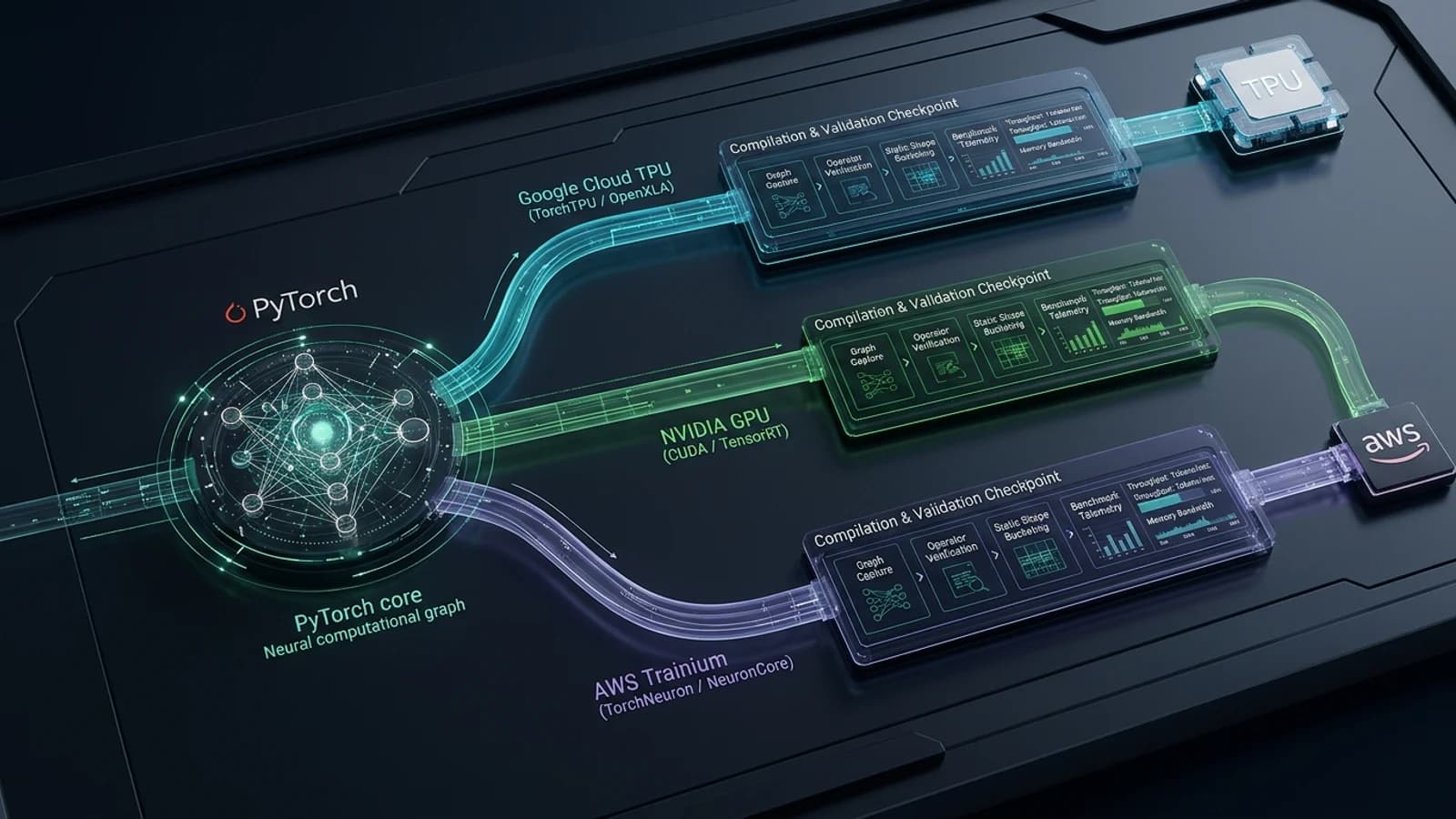
While Google Cloud Tensor Processing Units (TPUs) and AWS Trainium accelerators offered tantalizing promises of lower cost per floating-point operation, migrating an existing PyTorch codebase historically felt like rewriting software for a different operating system.
Developers had to contend with out-of-tree wrappers, fragile lazy-tensor abstraction layers, arcane compilation errors, and broken tensor view semantics. If a model did not compile cleanly on the first try, engineering teams inevitably retreated to the safety of NVIDIA H100, H200, and Blackwell clusters.
At the PyTorch Conference in late October 2026, that landscape shifted permanently.
Within forty-eight hours of each other, two landmark developments landed in the open-source ecosystem:
- Google and Meta open-sourced TorchTPU (`torch_tpu`), promoting Google Cloud TPUs (v5e, v5p, and Trillium v6e) to native, first-class PyTorch devices.
- AWS and the PyTorch Foundation introduced TorchNeuron, launching a public beta for a fully native PyTorch backend targeting AWS Trainium (Trn1, Trn2, and Trn3).
Both backends discard the legacy out-of-tree PyTorch/XLA wrappers in favor of PyTorch’s modern PrivateUse1 and torch.accelerator extension architectures.
On paper, the marketing claim is irresistible: *change .to("cuda") to .to("tpu") or .to("neuron"), call torch.compile(), and run your models at half the cloud cost.*
In production engineering, however, source-code portability is not workload portability.
A unified framework API lowers the migration threshold, but it cannot alter the physical realities of matrix engines, compilation graphs, memory layouts, or unsupported custom kernels.
.to("tpu") and .to("neuron")), eager debugging modes, native torch.compile lowering, and distributed primitives like FSDP2 and DTensor. However, migrating off NVIDIA is not a copy-paste operation. Custom CUDA/Triton kernels will crash, dynamic batching can trigger disastrous compilation storms, and unsupported operators force catastrophic CPU fallbacks. Teams evaluating non-NVIDIA accelerators must apply The Pathubs Accelerator Portability Checklist, benchmarking warm-run steady-state throughput and compilation overhead rather than raw theoretical FLOPS.---
1. What Changed at PyTorch Conference 2026?
To appreciate why TorchTPU and TorchNeuron represent a watershed moment, one must review the painful history of non-NVIDIA hardware in PyTorch.
Historical Model (2018–2025):
[PyTorch Code] ──► [torch_xla wrapper] ──► [Lazy Tensor Graph] ──► [XLA Compiler] ──► [TPU / Trainium]
(Broken in-place mutations, non-standard tensor subclasses, out-of-tree packaging desyncs)

Modern Native Model (October 2026):
[PyTorch Code] ──► [torch.device("tpu" | "neuron")] ──► [TorchDynamo / FX] ──► [Hardware Compiler]
(Native C++ tensor dispatch via PrivateUse1, in-tree API semantics, standard PyTorch views)
Historically, running PyTorch on Google TPUs or AWS Trainium required PyTorch/XLA. While pioneering, PyTorch/XLA was an external, out-of-tree integration that operated via *lazy execution*. Tensors were not executed immediately; instead, operations built up an internal computation graph that only dispatched to hardware when a tensor's data was explicitly requested (e.g., printing a value or calling .item()).
This created severe developer friction:
- In-Place Mutation Failures: Standard PyTorch idioms like
tensor[mask] = 0or in-place additions frequently failed or broke graph capture. - Packaging Synchronization Desync: When a new PyTorch version landed, developers often had to wait months for out-of-tree XLA binaries to catch up with CUDA releases.
- Debugging Blind Spots: Standard Python stack traces pointed deep into C++ XLA dispatchers rather than the actual line of failing PyTorch code.
The Standardized Accelerator Era
With PyTorch 2.x maturing, the PyTorch Foundation introduced the `PrivateUse1` mechanism and standardized the `torch.accelerator` API. This architecture allows silicon vendors to register a third-party accelerator directly into PyTorch's native C++ dispatcher.
Tensors on a TPU or Trainium are now ordinary PyTorch tensors. They share the exact same memory layout conventions, tensor view mechanisms, and dispatch keys as CPU or CUDA tensors.
---
2. TorchTPU Explained: Google Cloud TPUs Become First-Class
Co-developed by Google and Meta, TorchTPU (torch_tpu) officially open-sourced on 20 October 2026, replacing the legacy torch_xla codebase for modern TPU workloads.
         TORCHTPU ARCHITECTURAL RUNTIME
┌────────────────────────────────────────────────────────┐
│ PyTorch Application Code (`device="tpu"`)              │
└──────────────────────────┬─────────────────────────────┘
                           │
         ┌─────────────────┴─────────────────┐
         ▼                                   ▼
┌─────────────────────────┐       ┌──────────────────────┐
│       Eager Mode        │       │    Compiled Mode     │
│ • Strict (Async)        │       │   (torch.compile)    │
│ • Debug (Sync Bounds)   │       │ • TorchDynamo Graph  │
│ • DeferAndFuse (Fusion) │       │ • StableHLO Lowering │
└─────────────┬───────────┘       └──────────┬───────────┘
              │                              │
              ▼                              ▼
┌────────────────────────────────────────────────────────┐
│           OpenXLA Runtime & Memory Manager             │
└──────────────────────────┬─────────────────────────────┘
                           ▼
┌────────────────────────────────────────────────────────┐
│ Google Cloud TPU Hardware (v5e / v5p / Trillium v6e)   │
└────────────────────────────────────────────────────────┘
1. Native Dispatch via PrivateUse1
TorchTPU registers the tpu string as a native device backend. Importing torch_tpu automatically populates the device table:
import torch
import torch_tpu

# Direct, native device allocation
device = torch.device("tpu")
x = torch.randn(2048, 2048, device=device)
y = torch.randn(2048, 2048, device=device)
z = torch.matmul(x, y)
No specialized XLA wrappers or custom tensor classes are involved. The resulting tensor z is an authentic PyTorch tensor residing in TPU High Bandwidth Memory (HBM).
2. The Three Eager Execution Modes
A recurring complaint regarding TPUs was that eager execution yielded dismal throughput because every single operation incurred PCIe and host-dispatch latency. TorchTPU solves this by introducing three distinct eager behaviors:
- Strict Mode: Standard asynchronous dispatch. Operations are pushed to the TPU stream immediately. Excellent for standard scripts where latency is unconstrained.
- Debug Mode: Fully synchronous execution with immediate bounds-checking and NaN detection. If an operation produces invalid outputs, the Python traceback halts precisely at the offending line.
- DeferAndFuse Mode: An opportunistic hybrid mode. TorchTPU buffers contiguous elementwise and reduction operations, fusing them into a single TPU kernel launch before executing matrix multiplications. This drastically reduces HBM round-trips while preserving eager debugging semantics.
3. Compiled Mode via StableHLO and OpenXLA
For maximum production throughput, TorchTPU integrates directly with PyTorch's native compiler:
compiled_model = torch.compile(model, backend="tpu")TorchDynamo intercepts the PyTorch FX graph and lowers it into StableHLO (Stable High-Level Operations), an industry-standard intermediate representation. OpenXLA then compiles the StableHLO graph into highly optimized machine code specifically scheduled for the TPU's Matrix Multiplication Units (MXUs) and Vector Processing Units (VPUs).
4. Distributed Ecosystem Alignment
TorchTPU works seamlessly with Meta's distributed training primitives:
- FSDP2 (Fully Sharded Data Parallel 2): Native per-parameter sharding without manual XLA mesh definitions.
- DTensor and DeviceMesh: Direct multidimensional parallelism (tensor parallel + pipeline parallel + data parallel).
- vLLM-TorchTPU and SGLang-TorchTPU: Optimized serving backends for high-throughput LLM inference on Trillium v6e.
---
3. TorchNeuron Explained: Native AWS Trainium Execution
Concurrent with Google's release, AWS and the PyTorch Foundation announced the public beta of TorchNeuron (torch-neuronx), bringing native device integration to AWS Trainium (Trn1, Trn1n, Trn2, and the upcoming Trn3).
         TORCHNEURON ARCHITECTURAL RUNTIME
┌────────────────────────────────────────────────────────┐
│ PyTorch Application Code (`device="neuron"`)           │
└──────────────────────────┬─────────────────────────────┘
                           │
         ┌─────────────────┴─────────────────┐
         ▼                                   ▼
┌─────────────────────────┐       ┌──────────────────────┐
│   Adaptive Eager Mode   │       │    Compiled Mode     │
│ • Real-time dispatch    │       │   (torch.compile)    │
│ • JIT operator fusions  │       │ • TorchDynamo FX     │
│ • Direct Python inspect │       │ • Neuron Compiler JIT│
└─────────────┬───────────┘       └──────────┬───────────┘
              │                              │
              ▼                              ▼
┌────────────────────────────────────────────────────────┐
│     Neuron Runtime (libnrt.so) & Execution Engine      │
└──────────────────────────┬─────────────────────────────┘
                           ▼
┌────────────────────────────────────────────────────────┐
│ AWS Trainium Silicon (NeuronCore-v2 / NeuronCore-v3)   │
└────────────────────────────────────────────────────────┘
1. The Native `neuron` Device
Historically, Trainium required developers to compile models upfront using the torch-neuronx ahead-of-time (AOT) trace compiler (neuronx-cc), converting models into static TorchScript packages.
TorchNeuron eliminates this AOT packaging requirement. Trainium is now an addressable PyTorch device:
import torch
import torch_neuronx

device = torch.device("neuron")
model = MyTransformer().to(device)
2. Adaptive Eager Mode
AWS engineered an Adaptive Eager Mode that tracks operational patterns during execution. When an application executes loops or dynamic branching in Python, TorchNeuron executes the forward pass natively while streaming operator fusions down to the NeuronCore's Tensor Engine and Scalar Engine.
3. Native `torch.compile(..., backend="neuron")`
For production training and high-throughput inference, TorchNeuron provides a first-class TorchDynamo backend:
compiled_model = torch.compile(model, backend="neuron", dynamic=False)The Neuron compiler captures the forward and backward passes, maps operations across the chip's dual NeuronCores, and optimizes memory allocation across the chip's 32GB HBM2e memory banks.
4. Neuron Kernel Interface (NKI)
One of the most consequential features of TorchNeuron is the Neuron Kernel Interface (NKI).
Historically, if an engineer wrote an innovative attention mechanism or custom activation function, they could not run it on Trainium unless AWS's compiler team officially supported the operator. NKI changes this: it provides a Python-based bare-metal programming API (analogous to OpenAI's Triton or CUDA C++) that allows developers to write custom hardware kernels that compile directly into the Trainium instruction set.
---
4. Side-by-Side Architectural Comparison
While both backends share the goal of breaking the CUDA monoculture, their underlying engineering philosophies, compiler stacks, and hardware ecosystems differ significantly.
| Technical Dimension | TorchTPU (Google Cloud) | TorchNeuron (AWS) | Reference: CUDA Baseline (NVIDIA) |
|---|---|---|---|
| Primary Target Hardware | Cloud TPU v5e, v5p, Trillium v6e | Trainium Trn1, Trn1n, Trn2, Trn3 | H100, H200, B200 (Hopper / Blackwell) |
| Release State (Oct 2026) | Open Source (torch_tpu) | Public Beta (torch-neuronx) | Mature Production Standard |
| Device String | torch.device("tpu") | torch.device("neuron") | torch.device("cuda") |
| Dispatcher Mechanism | PyTorch PrivateUse1 | PyTorch PrivateUse1 / torch.accelerator | In-Tree First-Party C++ Dispatcher |
| Compiler Toolchain | StableHLO $\rightarrow$ OpenXLA | TorchDynamo FX $\rightarrow$ Neuron Compiler | TorchInductor $\rightarrow$ Triton / NVCC |
| `torch.compile` Syntax | torch.compile(m, backend="tpu") | torch.compile(m, backend="neuron") | torch.compile(m, backend="inductor") |
| Dynamic Shape Support | Partial (Bucketing recommended) | Strict Static (Requires dynamic=False) | Broad Dynamic Shape Support |
| Custom Kernel Language | Pallas / JAX / Triton-XLA | Neuron Kernel Interface (NKI) | Triton / CUDA C++ / Cutlass |
| Distributed Primitives | FSDP2, DTensor, tpu_dist | FSDP2, DTensor, Neuron Collective | NCCL, FSDP2, DeepSpeed |
| Inference Serving Engines | vLLM-TorchTPU, SGLang-TorchTPU | vLLM-Neuron, AWS Neuron Serving | vLLM, TensorRT-LLM, SGLang, TGI |
| On-Premise Availability | Cloud Only (GCP / Anthos Clusters) | Cloud Only (AWS EC2 / Outposts) | Everywhere (Cloud, On-Prem, Local PC) |
---
5. What "Minimal Code Changes" Really Means (The 5-Line Illusion)
Cloud providers and compiler teams frequently publish marketing snippets suggesting that model migration takes five lines of code:
# The Marketing Dream:
- import torch
- model = LlamaForCausalLM.from_pretrained("meta-llama/Llama-3-8B").to("cuda")
+ import torch, torch_tpu
+ model = LlamaForCausalLM.from_pretrained("meta-llama/Llama-3-8B").to("tpu")
If your model is an off-the-shelf, standard Hugging Face Transformer using standard linear layers and vanilla multi-head attention, this snippet might indeed execute.
However, in real-world production engineering, the five-line migration is almost always an illusion. Here is what happens when that code hits real infrastructure:
1. Custom Attention Kernels Crash Immediately
Modern high-performance LLM codebases rarely use standard torch.matmul for attention. They use FlashAttention-2, FlashDecoding, or custom Triton kernels.
These kernels are written in CUDA C++ or generate NVPTX bytecode. When TorchTPU or TorchNeuron encounters:
from flash_attn import flash_attn_func
out = flash_attn_func(q, k, v)
The execution will fail instantly with a runtime error (CUDA symbol not found or Invalid device pointer).
*The Engineering Fix:* You must refactor attention layers to use PyTorch SDPA (`torch.nn.functional.scaled_dot_product_attention`). Both TorchTPU and TorchNeuron hook into the SDPA dispatcher, automatically routing attention calculations to hardware-optimized matrix operations on their respective chips.
2. The Dynamic Shape Trap (Compilation Storms)
On NVIDIA GPUs with eager CUDA execution, passing a batch of sequence length 128, followed by 129, followed by 135 incurs zero compilation penalty. The GPU simply launches kernels over the varying tensor dimensions.
On TPUs and Trainium, the underlying compilers (OpenXLA and Neuron Compiler) perform aggressive, whole-graph static memory allocation. They schedule registers, SRAM, and matrix engine buffers for exact tensor dimensions.
If your data loader passes variable-length sequences without padding, the runtime triggers a compilation storm:
- Step 1 (length 128): Compiler freezes for 90 seconds to build graph A.
- Step 2 (length 129): Compiler freezes for 90 seconds to build graph B.
- Step 3 (length 135): Compiler freezes for 90 seconds to build graph C.
Within five minutes, the training process appears hung, memory balloons, and the host machine crashes with an Out-of-Memory (OOM) error.
*The Engineering Fix:* You must enforce static bucketing:
# Static sequence bucketing strategy
BUCKET_SIZES = [512, 1024, 2048, 4096]

def pad_to_nearest_bucket(tensor, buckets=BUCKET_SIZES):
    seq_len = tensor.shape[1]
    for b in buckets:
        if seq_len <= b:
            pad_amount = b - seq_len
            return torch.nn.functional.pad(tensor, (0, pad_amount)), b
    raise ValueError(f"Sequence length {seq_len} exceeds maximum bucket size {buckets[-1]}")
By constraining inputs to discrete bucket boundaries, you limit compilation to exactly four static graphs, allowing steady-state execution to proceed at maximum accelerator speed.
3. CPU Fallback Cascades
If an operation in your loss function or data pre-processing is not supported by the accelerator backend, PyTorch attempts to fall back to the CPU.
On an NVIDIA GPU, a minor CPU fallback causes a noticeable performance dip. On a TPU or Trainium cluster, a CPU fallback is fatal to throughput.
When an intermediate tensor is calculated on the host CPU, the system must:
- Block accelerator execution stream.
- Synchronize memory across the host-accelerator PCIe interconnect.
- Compute the single scalar or vector on the CPU.
- Copy the result back across the PCIe bus to TPU/Trainium HBM.
- Re-synchronize the hardware pipeline.
A single unsupported activation function or custom index operation can degrade training throughput by 80% to 95%.
---
6. A Production Device-Selection Example
To see how an enterprise application should be structured across backends, consider this production-grade device-agnostic initialization pattern:
import os
import torch

def configure_accelerator(preferred_backend: str = "auto") -> tuple[torch.device, str]:
    """
    Safely configures and registers the target PyTorch accelerator backend.
    Supports 'cuda', 'tpu', 'neuron', and 'cpu'.
    """
    backend = preferred_backend.lower()

    if backend in ("auto", "tpu"):
        try:
            import torch_tpu
            device = torch.device("tpu")
            # Verify connectivity with an ephemeral scalar allocation
            _ = torch.zeros(1, device=device)
            print("[Pathubs Infra] Successfully registered Google Cloud TPU backend.")
            return device, "tpu"
        except (ImportError, RuntimeError) as e:
            if backend == "tpu":
                raise RuntimeError(f"Explicit TPU backend requested but unavailable: {e}")

    if backend in ("auto", "neuron"):
        try:
            import torch_neuronx
            device = torch.device("neuron")
            _ = torch.zeros(1, device=device)
            print("[Pathubs Infra] Successfully registered AWS Trainium backend.")
            return device, "neuron"
        except (ImportError, RuntimeError) as e:
            if backend == "neuron":
                raise RuntimeError(f"Explicit Trainium backend requested but unavailable: {e}")

    if backend in ("auto", "cuda") and torch.cuda.is_available():
        device = torch.device("cuda")
        print(f"[Pathubs Infra] Registered NVIDIA CUDA backend: {torch.cuda.get_device_name(0)}")
        return device, "cuda"

    print("[Pathubs Infra] No hardware accelerator detected. Falling back to host CPU.")
    return torch.device("cpu"), "cpu"


def compile_model_for_backend(model: torch.nn.Module, backend_type: str) -> torch.nn.Module:
    """
    Applies backend-specific compilation flags and optimization strategies.
    """
    if backend_type == "tpu":
        # TorchTPU StableHLO lowering
        return torch.compile(model, backend="tpu")

    elif backend_type == "neuron":
        # TorchNeuron requires dynamic=False to prevent shape compilation storms
        return torch.compile(model, backend="neuron", dynamic=False)

    elif backend_type == "cuda":
        # Inductor with maximum autotuning on modern NVIDIA Tensor Cores
        return torch.compile(model, backend="inductor", mode="max-autotune")

    # Return vanilla model for CPU fallback
    return model
---
7. How to Benchmark Fairly: Cold Starts vs Steady State
A major reason why engineering evaluations of non-NVIDIA hardware fail is flawed benchmarking methodology. Teams often run a 50-step test script on a GPU, run the same script on a TPU or Trainium, observe that the TPU took ten times longer, and conclude that the alternative hardware is slow.
What they actually measured was compilation overhead, not accelerator throughput.
Benchmarking Phases:
[Cold Start: 0-120 seconds] ──────────► [Warm-Up: 1-10 iterations] ──────────► [Steady State: Production]
Graph capture, kernel compilation,        Memory allocation settling,           True tokens/sec throughput,
HBM memory layout scheduling             cache hits confirmed                  MBU / MFU utilization
(DO NOT BENCHMARK HERE)                  (DISCARD FROM METRICS)                (MEASURE & REPORT HERE)
The Seven Golden Rules of Accelerator Benchmarking
- Decouple Cold-Start Compilation from Steady-State Runs: Always measure the first iteration separately. In your benchmark report, explicitly publish two numbers:
- *Time to First Token / Initial Compilation Latency* (seconds) - *Steady-State Throughput* (tokens/second or samples/second)
- Match Numerical Precision Explicitly: Comparing NVIDIA FP8 (
e4m3ore5m2) against TPU Bfloat16 or Trainium Bfloat16 is fundamentally invalid. Fix precision across all devices (e.g., standard BF16) before comparing throughput. - Audit CPU Fallbacks with Verbose Flags: Run your models with environment variables that log graph breaks:
- For TorchTPU: TORCH_LOGS="+dynamo" TPU_LOG_OP_FALLBACK=1 - For TorchNeuron: NEURON_FRAMEWORK_DEBUG=1 TORCH_COMPILE_DEBUG=1 Verify that zero operations fall back to the host CPU during steady-state loops.
- Use Fixed Batch Sizes and Static Padding: Ensure test datasets are padded to identical static bounds across all candidate accelerators.
- Measure High Bandwidth Memory (HBM) High-Water Marks: Record peak memory consumption using native tools (
torch_tpu.get_memory_info()ortorch_neuronx.memory_stats()). - Calculate Real Cost per Million Inferences: An AWS
trn1.32xlargeor Google Cloudv5e-8instance has a very different hourly rate than an NVIDIAp5.48xlarge(8x H100). Calculate cost efficiency using real figures:
$$\text{Cost per Million Tokens} = \left(\frac{\text{Hourly Instance Rate}}{\text{Tokens Generated per Hour}}\right) \times 1,000,000$$
- Verify Numerical Parity: Run validation checks comparing model output logits against a reference float32 CPU baseline. If a model compiles cleanly on an accelerator but exhibits loss divergence after 1,000 steps, high throughput is meaningless.
---
8. The Pathubs Accelerator Portability Checklist
Before committing an engineering team to migrate a production training or serving pipeline away from NVIDIA, evaluate your workload across the six levels of The Pathubs Accelerator Portability Checklist:
      THE PATHUBS ACCELERATOR PORTABILITY CHECKLIST
┌────────────────────────────────────────────────────────┐
│ Level 1: Device & API Portability                      │
│ • Does code instantiate via torch.device("tpu|neuron")?│
│ • Are all hardcoded .cuda() calls eliminated?          │
└──────────────────────────┬─────────────────────────────┘
                           ▼
┌────────────────────────────────────────────────────────┐
│ Level 2: Operator & Library Coverage                   │
│ • Are all attention layers using native PyTorch SDPA?  │
│ • Are custom CUDA C++ and Triton kernels eliminated?   │
│ • Do third-party libraries (HF, vLLM) support backend? │
└──────────────────────────┬─────────────────────────────┘
                           ▼
┌────────────────────────────────────────────────────────┐
│ Level 3: Numerical Correctness                         │
│ • Do output logits match CPU/CUDA reference baseline?  │
│ • Is loss divergence bounded over 10,000 training steps│
│ • Are gradient accumulation epsilons numerically safe? │
└──────────────────────────┬─────────────────────────────┘
                           ▼
┌────────────────────────────────────────────────────────┐
│ Level 4: Compilation & Shape Stability                 │
│ • Are inputs statically padded or bucketed?            │
│ • Does torch.compile run without graph breaks?         │
│ • Are recompilation storms verified to be zero?        │
└──────────────────────────┬─────────────────────────────┘
                           ▼
┌────────────────────────────────────────────────────────┐
│ Level 5: Real Workload Performance                     │
│ • Does warm steady-state throughput beat target SLA?   │
│ • Is cold-start compilation latency acceptable?        │
│ • Are CPU-host memory round-trips eliminated?          │
└──────────────────────────┬─────────────────────────────┘
                           ▼
┌────────────────────────────────────────────────────────┐
│ Level 6: Cost & Operational Maturity                   │
│ • Does total cost per token beat the NVIDIA baseline?  │
│ • Are spot/preemptible instances readily available?    │
│ • Can on-call engineers debug failures without vendor? │
└────────────────────────────────────────────────────────┘
A project that passes Level 1 and Level 2 can be made to run in a few days. However, a project cannot be deployed to production until it rigorously passes all six levels.
---
9. Common Migration Mistakes to Avoid
In our technical reviews of early migrations to TorchTPU and TorchNeuron, we frequently observe four recurring architectural errors:
Mistake 1: Leaving Hardcoded `torch.cuda` Calls in Utilities
While the primary model forward pass is moved to .to(device), auxiliary scripts (evaluation loops, data collators, metric calculations, and profilers) often contain hardcoded calls like torch.cuda.synchronize() or torch.cuda.Event(). On non-NVIDIA systems, these calls fail with runtime attribute exceptions. Always replace them with device-agnostic alternatives: torch.accelerator.synchronize() where supported, or wrap them in conditional checks.
Mistake 2: Assuming Ahead-of-Time Model Size Equals HBM Consumption
Engineers calculate: *"My 8B parameter model in BF16 is 16GB. The Trainium chip has 32GB HBM, so it fits easily."*
They forget that torch.compile generates activation buffers, optimizer states (if training), KV-caches (if serving), and intermediate compiler workbuffers. If activation checkpointing is not enabled, activation memory during backward passes can easily consume double the model weight size, causing sudden compiler allocation failures.
Mistake 3: Relying on Dynamic Sequence Lengths in Serving
In web-scale inference serving (e.g., serving a chatbot), incoming user prompts vary from 5 tokens to 3,000 tokens. Serving raw dynamic shapes directly to a compiled TPU or Trainium backend causes the engine to recompile continuously during production traffic.
Always deploy through dedicated inference engines like vLLM-TorchTPU or vLLM-Neuron, which pre-allocate static PagedAttention KV-cache blocks and enforce discrete sequence bucketing out of the box.
Mistake 4: Benchmarking Without Warm-Up Iterations
Publishing a performance report showing that an alternative accelerator is *"slower than an old A100"* because the test script ran only ten iterations. The first three iterations were compiling the graph; iterations four through ten were warming up caches. Reliable benchmarks must execute a minimum of 100 to 500 iterations, explicitly discarding the first twenty runs.
---
10. Final Decision Matrix: Which Accelerator Fits Your Team?
Migrating beyond NVIDIA is an infrastructure and financial decision, not a matter of developer dogma. Use this decision matrix to determine the optimal compute strategy for your organization:
┌────────────────────────────────────────────────────────────────────────┐
│                   ACCELERATOR SELECTION DECISION MATRIX                │
├─────────────────────┬──────────────────────────────────────────────────┤
│ Choose NVIDIA GPUs  │ • Workload relies on custom CUDA/Triton kernels  │
│ (CUDA / TensorRT)   │ • Rapid exploratory research with dynamic shapes │
│                     │ • Low tolerance for compilation latency overhead │
│                     │ • Deployment requires multi-cloud or on-premise  │
├─────────────────────┼──────────────────────────────────────────────────┤
│ Choose Google Cloud │ • Training standard architectures (Llama, MoE,   │
│ TPUs (TorchTPU)     │   Diffusion) at massive scale in Google Cloud    │
│                     │ • Serving high-volume inference via vLLM-TorchTPU│
│                     │ • Team already leverages JAX or GKE clusters     │
│                     │ • Workload can be statically bucketed            │
├─────────────────────┼──────────────────────────────────────────────────┤
│ Choose AWS Trainium │ • Enterprise infrastructure is centered in AWS   │
│ (TorchNeuron)       │ • Large-scale pre-training or fine-tuning runs   │
│                     │   where 30-50% compute savings justify porting   │
│                     │ • Team can write custom NKI kernels if needed    │
│                     │ • Static batch inference deployments on EC2      │
└─────────────────────┴──────────────────────────────────────────────────┘
---
Final Takeaway: The Era of Hardware Agnostic PyTorch Has Begun
For the first time in the history of deep learning, running PyTorch on Google TPUs and AWS Trainium no longer feels like working with a fragile second-class fork.
The arrival of TorchTPU and TorchNeuron in late 2026 establishes a standardized, in-tree accelerator model. Silicon diversity is no longer theoretical; it is an accessible engineering reality.
However, true senior engineering requires distinguishing between syntactic compatibility and production readiness.
Changing a device string is the easiest step in the journey. The real engineering discipline lies in:
- Eliminating proprietary CUDA dependencies in favor of standardized PyTorch SDPA.
- Architecting strict static padding and bucketing strategies to prevent compilation storms.
- Benchmarking steady-state throughput and total cost per token rather than relying on vendor slide decks.
Teams that master this discipline will break free from cloud hardware shortages, negotiate from positions of operational strength, and deploy resilient models across whatever silicon delivers the highest performance per dollar.
---
Sources & Further Reading
- Google Cloud Infrastructure Blog: *TorchTPU is Now Open Source: Run Native PyTorch on Google Cloud TPUs* — Official Announcement (October 2026).
- Google Cloud Documentation: *PyTorch on Cloud TPU Architecture and StableHLO Lowering* — Official TPU Documentation (cloud.google.com/tpu/docs/pytorch-on-tpu).
- PyTorch Foundation Blog: *Introducing TorchNeuron: Native PyTorch Backend for AWS Trainium* — Official Release Notes (pytorch.org/blog, October 2026).
- AWS Neuron Documentation: *TorchNeuron Architecture, Adaptive Eager Mode, and NKI Kernel Programming Guide* — AWS Documentation (awsdocs-neuron.readthedocs-hosted.com).
- PyTorch Core Architecture: *PyTorch Device Extensions: The PrivateUse1 Dispatch Mechanism and Accelerator APIs* — PyTorch Documentation (pytorch.org/docs).
- Hugging Face Engineering: *Running Hugging Face Transformers on Cloud TPUs with Native Device Maps* — Hugging Face Documentation (huggingface.co).