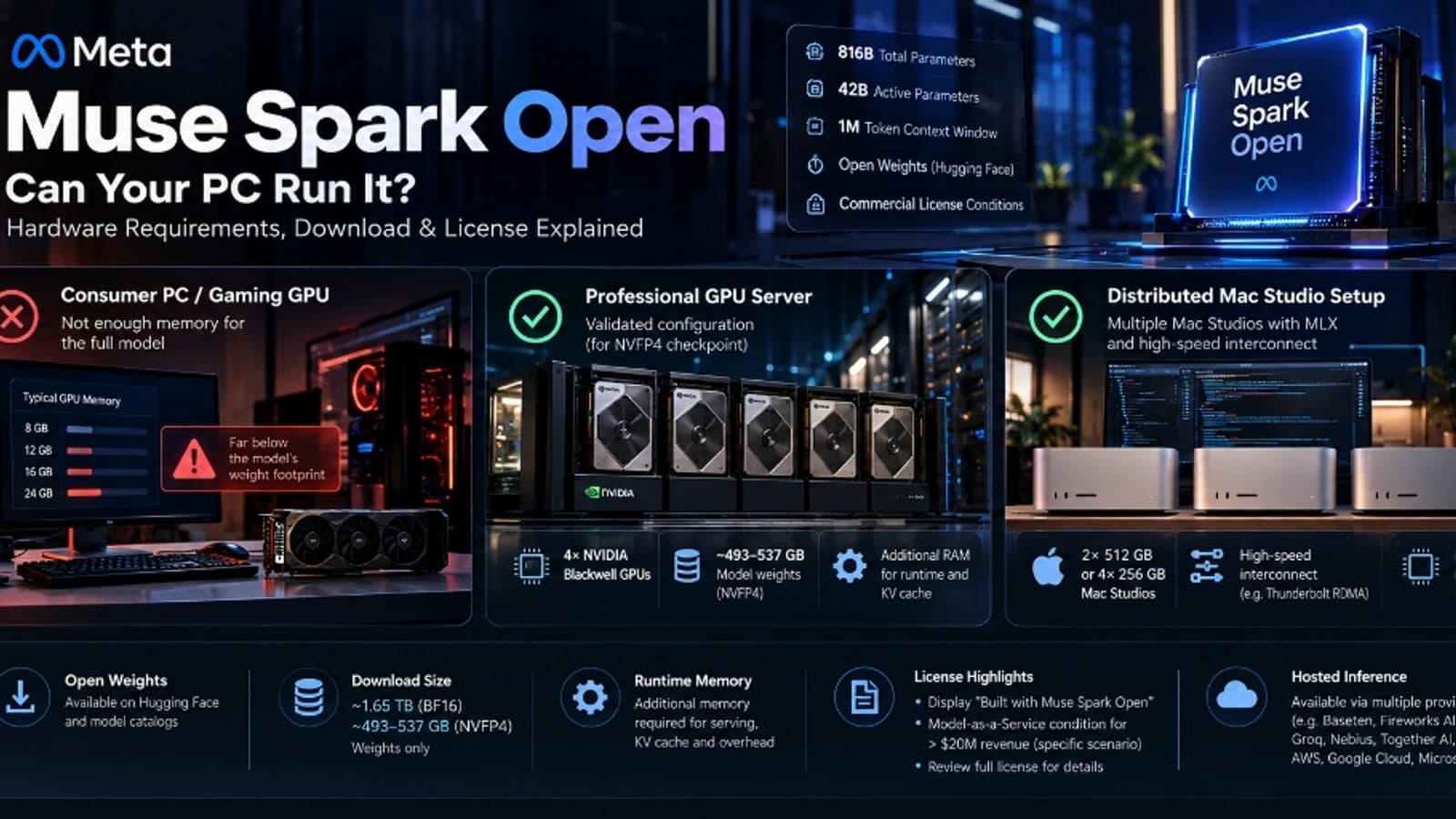
On 15 October 2026, Meta officially released Muse Spark Open—a flagship, frontier-class artificial intelligence model published with accessible model weights on Hugging Face. Billed as Meta's most capable open-weights system to date, the model boasts a staggering 816 billion total parameters, a 1-million-token context window, and an advanced Sparse Mixture-of-Experts (MoE) architecture activating 42 billion parameters per token.
The open release sparked immediate excitement across the developer and local-LLM communities. Within hours, developers began asking the fundamental question:
*“Can I download the weights from Hugging Face and run Muse Spark Open locally on my workstation?”*
The short answer for almost every individual developer is no. While the model weights are public, serving an 816-billion-parameter architecture requires enterprise-scale memory bandwidth and infrastructure that far exceeds consumer workstations.
---
1. What Is Muse Spark Open? Architecture & Core Specifications
To evaluate the hardware required to run Muse Spark Open, developers must first understand its foundational architecture. Meta designed Muse Spark Open as a Sparse Mixture-of-Experts (MoE) transformer rather than a monolithic dense network.
┌─────────────────────────────────────────────────────────────────────────────┐
│                 META MUSE SPARK OPEN: ARCHITECTURAL MATRIX                  │
├──────────────────────────┬──────────────────────────────────────────────────┤
│ Total Parameter Count    │ 816 Billion Parameters                           │
├──────────────────────────┼──────────────────────────────────────────────────┤
│ Active Parameters / Token│ 42 Billion Parameters (MoE Top-K Routing)        │
├──────────────────────────┼──────────────────────────────────────────────────┤
│ Context Window Capacity  │ 1,048,576 Tokens (1M Native Context)             │
├──────────────────────────┼──────────────────────────────────────────────────┤
│ Native Precision Format  │ BF16 (bfloat16) ~1.65 TB Raw Checkpoint          │
├──────────────────────────┼──────────────────────────────────────────────────┤
│ Quantized Target Format  │ NVFP4 (NVIDIA 4-bit Floating Point) ~537 GB      │
├──────────────────────────┼──────────────────────────────────────────────────┤
│ Primary Modalities       │ Multilingual Text, Code, Complex Reasoning, Tool │
├──────────────────────────┼──────────────────────────────────────────────────┤
│ Distribution License     │ Bespoke Muse Model License (Commercial / MaaS)   │
└──────────────────────────┴──────────────────────────────────────────────────┘
The Difference Between Total and Active Parameters
A dense model (such as Llama 3.1 70B or 405B) activates every single weight matrix during every forward pass. In contrast, an MoE model divides its feed-forward network (FFN) layers into multiple specialized "experts."
When an input token is processed by Muse Spark Open:
- A routing gate calculates softmax probability scores across all available expert networks.
- The model dispatches the token exclusively to the top-scoring experts, totaling 42 billion active parameters.
- The remaining 774 billion parameters remain idle for that specific token calculation.
This architectural design delivers the reasoning depth of an 800B+ model while preserving the forward-pass compute budget (FLOPs) of a much smaller 42B model. However, as we will explore below, computational efficiency does not reduce RAM requirements.
---
2. Can You Run It on a Normal PC? The MoE Memory Trap
A widespread misconception among developers encountering MoE models is assuming that memory requirements match active parameter count:
$$\text{Mistaken Assumption: } 42\text{B active parameters} \times 2\text{ bytes} \approx 84\text{ GB VRAM}$$
In reality, routing is dynamic and per-token. Token $A$ in a sentence may route to Experts 3 and 12, while Token $B$ routes to Experts 1 and 8. Because the routing gate can invoke any expert at any millisecond during token generation, the entire 816-billion-parameter weight graph must reside permanently in fast memory.
MEMORY USAGE PROFILE:
┌─────────────────────────────────────────────────────────────────────────────┐
│ ❌ CONSUMER GPU (RTX 4090 - 24 GB VRAM)                                     │
│ [24 GB Available]                                                           │
│ █ 4.4% of required NVFP4 weight footprint                                  │
├─────────────────────────────────────────────────────────────────────────────┤
│ ❌ DUAL CONSUMER GPU (2x RTX 3090 - 48 GB VRAM)                             │
│ [48 GB Available]                                                           │
│ ██ 8.9% of required NVFP4 weight footprint                                  │
├─────────────────────────────────────────────────────────────────────────────┤
│ ✅ ENTERPRISE NODE (4x NVIDIA B200 / 8x H100 - 768 GB+ VRAM)                │
│ [768 GB - 1536 GB High-Bandwidth VRAM]                                      │
│ ████████████████████████████████████████ Full Checkpoint + 1M KV-Cache      │
└─────────────────────────────────────────────────────────────────────────────┘
Hardware Feasibility Summary
| Hardware Platform | Memory Capacity | Model Compatibility | Practical Verdict |
|---|---|---|---|
| Mid-range PC (RTX 4070) | 12 GB GDDR6X | Fails to hold 3% of weights | Impossible (Instant OOM) |
| Flagship Gaming PC (RTX 4090) | 24 GB GDDR6X | Fails to hold 5% of weights | Impossible (Instant OOM) |
| High-end Workstation (2x RTX 4090) | 48 GB GDDR6X | Fails to hold 10% of weights | Impossible (Instant OOM) |
| Single Apple Mac Studio M2 Ultra | 192 GB Unified | Insufficient memory | Impossible (Cannot fit 493 GB) |
| Single Apple Mac Studio (Max Spec) | 512 GB Unified | Exceeded by OS + KV-Cache | Infeasible (OOM under load) |
| Apple Mac Studio Cluster (2x–4x) | 768 GB–1024 GB Unified | Validated via MLX RDMA | Viable Specialized Local Setup |
| NVIDIA Blackwell Node (4x B200) | 768 GB HBM3e | Official NVFP4 configuration | Certified Reference Production |
| NVIDIA Hopper Cluster (8x H100) | 640 GB–1120 GB HBM3 | Official BF16 configuration | Enterprise High-Throughput |
Even with aggressive CPU system-RAM offloading (e.g., using system DDR5 memory over PCIe), memory bandwidth drops from 1,000+ GB/s to roughly 60 GB/s. At that bandwidth, generating a single token would take over 15 to 30 seconds, rendering the model practically unusable.
---
3. What Hardware Does It Actually Need?
Meta's official hardware configuration documentation outlines two certified reference deployment patterns: the uncompressed BF16 checkpoint and the optimized NVFP4 checkpoint.
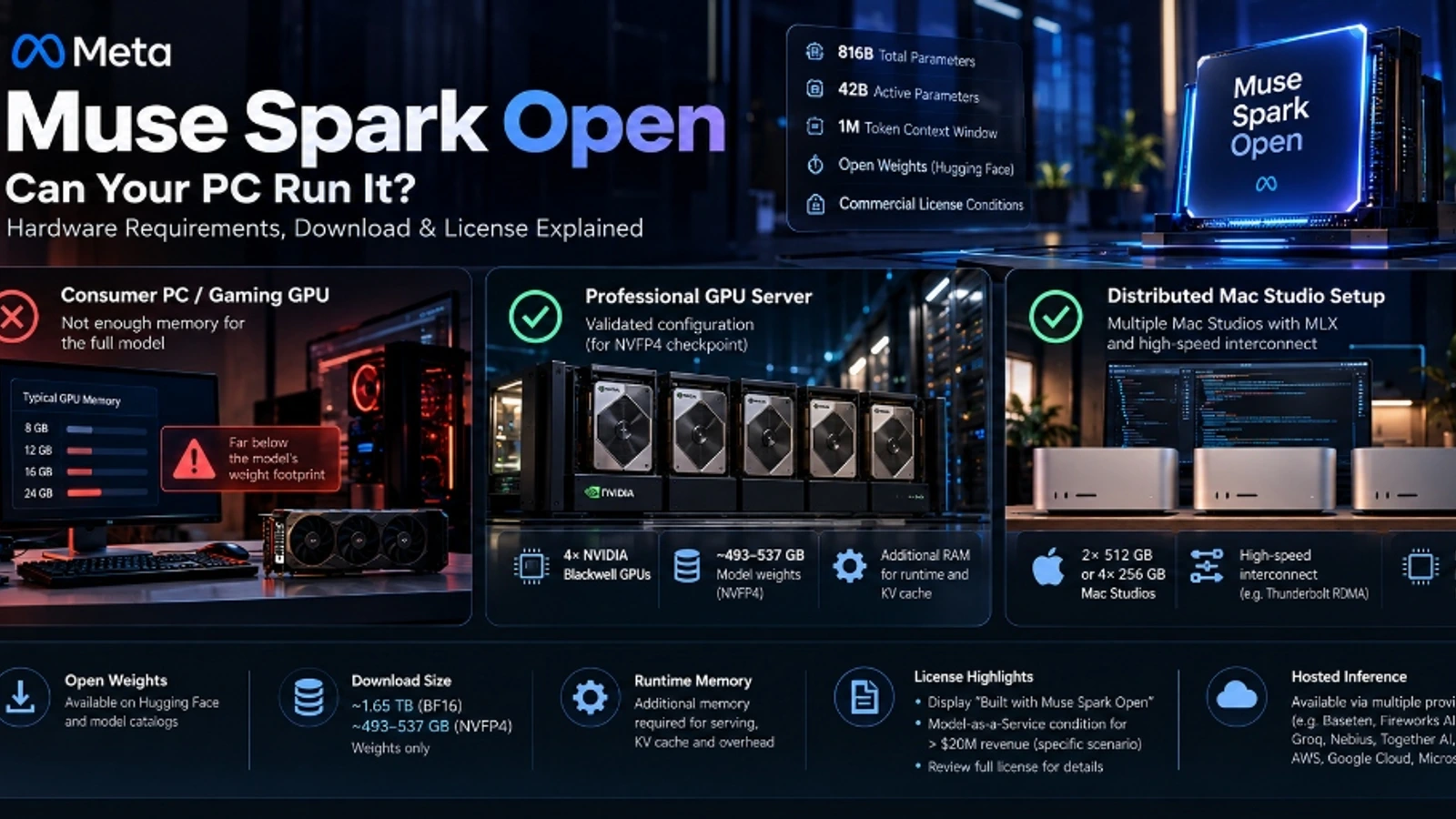
Checkpoint 1: BF16 Native Precision (~1.65 TB)
For research laboratories and enterprises requiring bit-for-bit numerical fidelity without quantization loss, Meta provides the uncompressed BF16 weights.
- Storage Footprint: Approximately 1,650 GB (1.65 TB) on disk.
- Validated Server Topology: A cluster of eight high-end enterprise GPUs (such as 8x NVIDIA H100 80GB SXM5 or H200 141GB).
- Interconnect Requirement: High-speed NVLink switches (900 GB/s bidirectional per GPU) are required to distribute tensor-parallel and pipeline-parallel expert computations across the GPUs without catastrophic communication latency.
Checkpoint 2: NVFP4 Compressed Precision (~537 GB)
To make serving viable outside of hyper-scaler data centers, Meta partnered with NVIDIA to validate a 4-bit floating-point (NVFP4) checkpoint leveraging Blackwell Tensor Core native FP4 decompression.
- Storage Footprint: Approximately 537 GB on NVMe storage.
- Validated Server Topology: Four NVIDIA Blackwell GPUs (e.g., 4x B200 with 192 GB HBM3e per card, providing 768 GB total VRAM).
- Why 537 GB Requires 768 GB VRAM: Model weights alone represent static overhead. When serving real user requests, three additional memory consumers compete for VRAM:
1. Framework Runtime Buffers: vLLM, TensorRT-LLM, or SGLang allocate scratchpads for intermediate matrix multiplications (GEMM). 2. Activation Memory: Intermediate layer activations during multi-turn reasoning. 3. The 1M KV-Cache Footprint: Serving a 1,048,576-token context window dynamically consumes memory for attention key-value projections. Even with Grouped-Query Attention (GQA), a long-context request can consume tens of gigabytes of VRAM per concurrent stream.
---
4. The Local Mac Setup: Distributed MLX over Thunderbolt
The most significant development for local-AI practitioners is Apple's collaborative technical report on distributed MLX inference.
Apple's machine learning research team demonstrated that while Muse Spark Open cannot run on a single desktop computer, it can be served locally on a cluster of networked Apple Silicon Mac Studios.
┌─────────────────────────────────────────────────────────────────────────────┐
│             APPLE MLX DISTRIBUTED TOPOLOGY FOR MUSE SPARK OPEN              │
├─────────────────────────────────────────────────────────────────────────────┤
│                                                                             │
│   ┌───────────────────────────┐           ┌───────────────────────────┐     │
│   │   MAC STUDIO 1 (M2/M3)    │           │   MAC STUDIO 2 (M2/M3)    │     │
│   │   Unified Memory: 512 GB  │ ◄───────► │   Unified Memory: 512 GB  │     │
│   │   Assigned: Experts 1..16 │           │   Assigned: Experts 17..32│     │
│   └─────────────┬─────────────┘           └─────────────┬─────────────┘     │
│                 │                                       │                   │
│                 │      HIGH-SPEED POINT-TO-POINT        │                   │
│                 └─────► RDMA OVER THUNDERBOLT 5 ◄───────┘                   │
│                         (Bidirectional PCIe Bridge)                         │
│                                                                             │
└─────────────────────────────────────────────────────────────────────────────┘
Why a Single 512 GB Mac Studio Fails
Apple's report measured the raw in-memory weight footprint of the quantized model at approximately 493 GB.
Although Apple produces a Mac Studio configured with 512 GB of unified memory, running the model on a single machine causes immediate system termination:
- macOS reserves a mandatory operating system window (typically 16 GB to 32 GB) for display buffers, unified memory kernel management, and system daemons.
- Metal Performance Shaders (MPS) allocate driver overhead for buffer page-tables.
- Once the model loads, virtually 0 MB remains for the context KV-cache. The first user prompt triggers macOS memory compression and causes an out-of-memory kernel panic.
The Multi-Node Solution: RDMA over Thunderbolt
To bypass the single-node physical ceiling, Apple's engineers implemented Remote Direct Memory Access (RDMA) over Thunderbolt cables within the MLX framework:
- Cluster Topology: Two or more Mac Studio units (e.g., two 512 GB units providing 1,024 GB total memory, or four 256 GB units) are linked via point-to-point Thunderbolt 4/5 connections.
- Model Parallelism: The 816B weights are split across machines. Each Mac Studio loads a subset of the expert layers directly into its local unified memory pool.
- Pipelined Execution: When token routing requires an expert housed on an adjacent machine, memory buffers exchange activation vectors across the Thunderbolt bus without CPU serialization.
Under this distributed MLX benchmark configuration, Apple demonstrated sustained generation throughput reaching over 36 tokens per second. While this proves local inference is technically achievable, the combined cost of multiple top-tier Mac Studios ($14,000–$20,000+) places this setup primarily in the realm of boutique AI labs and well-funded startups.
---
5. What Are Your Realistic Options?
If you do not possess an enterprise NVIDIA server cluster or multiple networked Mac Studios, how can you realistically build with Muse Spark Open? Developers have three practical paths:
┌─────────────────────────────────────────────────────────────────────────────┐
│                      PRACTICAL DEPLOYMENT PATHWAYS                          │
├─────────────────────┬──────────────────────┬────────────────────────────────┤
│ 1. Hosted Cloud API │ Low Cost / Zero Ops  │ Best for 95% of developers     │
├─────────────────────┼──────────────────────┼────────────────────────────────┤
│ 2. Cloud GPU Rental │ Medium Cost / Custom │ Best for fine-tuning & privacy │
├─────────────────────┼──────────────────────┼────────────────────────────────┤
│ 3. Scaled Down Local│ Free / Consumer GPU  │ Best for offline local coding  │
└─────────────────────┴──────────────────────┴────────────────────────────────┘
Option 1: Hosted Inference APIs (Recommended)
At launch, Meta collaborated with leading cloud AI providers to offer immediate API endpoints. Hosted inference eliminates all hardware acquisition, cooling, power, and maintenance overhead:
- Specialized High-Speed Providers: Platforms such as Fireworks AI, Together AI, Groq, and Baseten provide pay-as-you-go REST and OpenAI-compatible API endpoints.
- Aggregators: OpenRouter aggregates multiple upstream providers, allowing developers to route prompts dynamically based on real-time price and latency.
- Hyperscaler Model Catalogs: Enterprise teams can deploy managed instances via AWS SageMaker AI, Google Cloud Model Garden, and Microsoft Azure Foundry Models.
Option 2: On-Demand Cloud Multi-GPU Rental
If your application requires custom fine-tuning, proprietary weight modifications, or strict tenant isolation:
- Rent on-demand nodes from specialized compute providers like Modal, Nebius, Lambda Labs, or RunPod.
- A 4x H100 or 8x H100 instance can be spun up for the hours needed to run benchmarks, costing roughly $12 to $25 per hour rather than tens of thousands in capital expenditure.
Option 3: Practical Local Alternatives for Consumer PCs
If your goal is strictly private, offline local execution on a standard laptop or desktop, consider smaller models specifically optimized for consumer VRAM:
- For 8 GB–12 GB VRAM: Run Llama 3.2 3B/8B, Mistral 7B, or Qwen 2.5 7B via Ollama or LM Studio.
- For 16 GB–24 GB VRAM (RTX 4090 / Mac M3 Max): Run Llama 3.3 70B quantized at 4-bit (Q4_K_M) or DeepSeek-Coder-V2-Lite (16B MoE with 2.4B active parameters).
---
6. The Pathubs Local-Model Feasibility Check
To evaluate whether any newly released open-weights model can realistically run on your existing infrastructure, Pathubs has developed the 5-Dimension Local-Model Feasibility Check:
┌─────────────────────────────────────────────────────────────────────────────┐
│               THE PATHUBS LOCAL-MODEL FEASIBILITY CHECK                     │
├─────┬──────────────────────┬────────────────────────────────────────────────┤
│ D1  │ Weight Footprint     │ Total disk storage needed for checkpoint files │
│ D2  │ Addressable Memory   │ Static weights + 20% runtime buffer + KV-cache │
│ D3  │ Bus Interconnect     │ >900 GB/s NVLink or Thunderbolt RDMA bandwidth │
│ D4  │ Target Throughput    │ Sustainable tokens/sec under multi-turn loads  │
│ D5  │ Licensing Fit        │ Commercial redistribution & MaaS restrictions  │
└─────┴──────────────────────┴────────────────────────────────────────────────┘- Weight Footprint (D1): Never evaluate model feasibility based on active parameter count. Calculate static memory using the model's total parameter count:
$$\text{Static Footprint (GB)} \approx \text{Total Parameters (Billions)} \times \frac{\text{Bit Precision}}{8}$$ For an 816B model at 4-bit, this baseline is roughly $816 \times 0.5 = 408\text{ GB}$, scaling up to 537 GB with metadata, tensor alignment, and quantization scale factors.
- Addressable Memory (D2): Ensure your available physical VRAM/unified memory exceeds the static weight footprint by at least 20% to 30% to avoid out-of-memory errors when processing long context windows.
- Bus Interconnect (D3): Splitting weights across multiple consumer GPUs over standard PCIe Gen 4 slots (32 GB/s) causes severe pipeline stalls. High-performance MoE serving mandates NVLink (NVIDIA) or high-speed Thunderbolt bridging (Apple).
- Target Throughput (D4): Verify that your configuration delivers acceptable generation latency (>15 tokens/sec). Anything below 5 tokens/sec creates a degraded developer experience.
- Licensing Compliance (D5): Confirm that your commercial business model does not violate downstream vendor restrictions.
---
7. Where to Download and How to Start
If you have verified that your infrastructure fulfills the necessary memory and interconnect requirements, access the official release assets through the following channels:
1. Model Weights Repository (Hugging Face)
Meta hosts the primary model checkpoints on the Hugging Face hub under gated access:
- Hugging Face Hub: meta-models/Muse-Spark-Open-816B-A42B
- Access Requirements: You must be logged into a verified Hugging Face account and accept Meta's Muse Model License agreement.
- Disk Space Warning: Do not initiate download commands (
git lfs cloneorhuggingface-cli download) without ensuring your target volume has at least 600 GB of free NVMe storage for the NVFP4 checkpoint, or 2.0 TB for the full BF16 checkpoint.
# Verify available storage before initiating download
df -h /data/models

# Download NVFP4 checkpoint via Hugging Face CLI
huggingface-cli download meta-models/Muse-Spark-Open-816B-A42B \
  --include "*.nvfp4*" \
  --local-dir /data/models/muse-spark-open-nvfp4
2. Official Documentation & Technical Guides
- Meta AI Research Blog: Official Model Announcement
- Meta Developer Portal: Build with Muse Spark Open Guide
- Hardware Platforms Documentation: Hardware Configurations & Benchmarks
- Apple Machine Learning Research: MLX Distributed Inference Technical Report
---
8. Is Muse Spark Open Really "Open Source"?
In technical discussions, the terms "open source" and "open weights" are frequently conflated. It is critical to recognize that Muse Spark Open is not open source software under the Open Source Initiative (OSI) definition.
Like Llama 3 before it, Muse Spark Open is an open-weights model governed by a custom commercial license.
┌─────────────────────────────────────────────────────────────────────────────┐
│                 OPEN WEIGHTS vs. OSI OPEN SOURCE LICENSING                  │
├───────────────────────────────┬─────────────────────────────────────────────┤
│ OSI Open Source (MIT/Apache)  │ Meta Muse Model License                     │
├───────────────────────────────┼─────────────────────────────────────────────┤
│ • Full source code access     │ • Model weights & inference code provided   │
│ • Complete training data open │ • Training datasets & recipes NOT disclosed │
│ • Zero commercial restrictions│ • Revenue thresholds on MaaS providers      │
│ • No attribution mandates     │ • Mandatory "Built with Muse" attribution   │
│ • Unconditional redistribution│ • Prohibits using outputs to train rivals   │
└───────────────────────────────┴─────────────────────────────────────────────┘
The model weights, tokenizer configs, and inference reference implementations are freely downloadable, inspectable, and fine-tuneable. However, Meta imposes specific commercial and operational conditions that distinguish it from permissive open-source licenses like Apache 2.0 or MIT.
---
9. Can You Use It Commercially? The License Conditions Explained
Before integrating Muse Spark Open into a production application, startup product, or SaaS backend, legal and engineering teams must evaluate two critical provisions in the Muse Model License:
1. The Mandatory Attribution Clause
Section 2 of the Muse Model License specifies that any product, service, or customer-facing application powered directly by Muse Spark Open (or any fine-tuned derivative model) must prominently display:
> *"Built with Muse Spark Open"*
This attribution must appear on user interfaces, documentation, or marketing collateral where underlying AI capabilities are described.
2. The $20 Million Model-as-a-Service (MaaS) Condition
The most widely discussed provision in the license governs third-party cloud hosting providers.
THE $20M MAAS RULE:
┌────────────────────────────────────────────────────────┐
│ DOES YOUR ENTITY GENERATE > $20M ANNUAL GROSS REVENUE? │
└──────────────────────────┬─────────────────────────────┘
                           │
             ┌─────────────┴─────────────┐
             ▼                           ▼
          [ YES ]                     [ NO ]
             │                           │
  Does your product offer         Freely permitted to
  Model-as-a-Service (MaaS)?      use commercially
             │                    under standard terms.
      ┌──────┴──────┐
      ▼             ▼
   [ YES ]       [ NO ]
      │             │
  Mandatory      Freely permitted
  Separate       for internal enterprise
  Commercial     applications, SaaS apps,
  Agreement      and workflow tooling.
with Meta.- What the Clause Actually Regulates: If a company (including its global affiliates) generates more than USD $20 million in aggregate gross revenue during any consecutive 12-month period, AND provides commercial API access to the model on a Model-as-a-Service (MaaS) basis to third parties, that company must enter into a separate written commercial agreement with Meta.
- What the Clause Does NOT Prohibit: A Fortune 500 enterprise earning $100M+ annually is fully permitted to use Muse Spark Open internally—for customer support bots, internal code generation, document summarization, or analytical pipelines—without paying licensing fees or requiring a custom agreement, provided it is not reselling raw model API queries to outside developers.
*(Disclaimer: This breakdown provides technical and architectural context based on published license terms. It does not constitute formal legal counsel. Enterprise teams should consult qualified intellectual property attorneys when structuring commercial deployments.)*
---
10. Which Deployment Path Should You Choose?
To assist engineering leaders and developers in selecting the optimal deployment strategy, Pathubs has structured this decision matrix based on team profile, budget, and infrastructure:
┌─────────────────────────────────────────────────────────────────────────────┐
│                 MUSE SPARK OPEN: ADOPTION DECISION MATRIX                   │
├──────────────────────┬──────────────────────┬───────────────────────────────┤
│ User Profile         │ Hardware Available   │ Recommended Deployment Path   │
├──────────────────────┼──────────────────────┼───────────────────────────────┤
│ Student / Hobbyist   │ Gaming Laptop / PC   │ Use Hosted Cloud APIs         │
│                      │ (8GB–16GB VRAM)      │ (Together AI, Groq, Fireworks)│
├──────────────────────┼──────────────────────┼───────────────────────────────┤
│ Indie Developer /    │ Mac M3/M4 or         │ Use Smaller Local Models      │
│ Local AI Enthusiast  │ Single Workstation   │ (Llama 3.3 70B via Ollama)    │
├──────────────────────┼──────────────────────┼───────────────────────────────┤
│ AI Startup (Pre-seed)│ Cloud Credit Grant   │ Serverless GPU Hosting        │
│ Prototyping Features │ (AWS / GCP / Modal)  │ (OpenRouter / Modal endpoints)│
├──────────────────────┼──────────────────────┼───────────────────────────────┤
│ AI Research Lab /    │ Multi-Node Cluster   │ Distributed Apple MLX         │
│ Boutique Agency      │ (Multiple Mac Studio)│ (RDMA over Thunderbolt)       │
├──────────────────────┼──────────────────────┼───────────────────────────────┤
│ Enterprise Tech Team │ Enterprise Cloud VPC │ Dedicated 4x Blackwell Node   │
│ Production Workloads │ (Private Cloud IAM)  │ (vLLM / TensorRT-LLM NVFP4)   │
└──────────────────────┴──────────────────────┴───────────────────────────────┘
---
11. Final Takeaway
Meta Muse Spark Open represents a monumental milestone for open-weights artificial intelligence. Delivering frontier-tier intelligence across an 816-billion-parameter MoE architecture with a native 1-million-token context window pushes the boundaries of open research.
However, democratizing model weights is not the same as democratizing model execution.
For individual software engineers and developers with standard hardware, attempting to download and serve Muse Spark Open locally on a single machine is an exercise in futility. The memory physics of an 816B parameter graph cannot be negotiated.
The smart engineering approach in 2026 is clear: leverage pay-as-you-go hosted APIs for rapid prototyping and application building, explore distributed Apple Silicon clusters if you have specialized on-premise privacy requirements, and reserve full multi-GPU Blackwell cluster deployments for high-throughput enterprise production.
To deepen your understanding of large language model serving, memory optimization, and test-time compute scaling, explore our companion guides on LLM Prompt Cache Misses & KV-Cache Dynamics and LLM Reasoning Budgets & Inference Scaling. If you are preparing for production AI engineering roles, explore the comprehensive Pathubs AI Engineering Career Roadmap.
---
Sources & Further Reading
- Meta AI Research: *"Introducing Muse Spark Open: Frontier Open-Weights Reasoning with 816B Sparse MoE Architecture"* (Published: 15 October 2026) — Official Announcement.
- Meta Developer Portal: *"Build with Muse Spark Open: Reference Implementations & Serving Best Practices"* — Meta Developer Documentation.
- Meta Infrastructure Engineering: *"Hardware Platforms and Memory Topologies for Muse Spark Open Inference"* — Hardware Configuration Guide.
- Hugging Face Model Hub: *"meta-models/Muse-Spark-Open-816B-A42B Checkpoint Repository and Artifact Files"* — Hugging Face Repository.
- Meta Open Research: *"Muse Model License and Acceptable Use Policy"* (Version 1.0) — Official License Text.
- Apple Machine Learning Research: *"Distributed Inference for 800B+ MoE Architectures Using MLX and Thunderbolt RDMA"* (October 2026) — Apple ML Research Report.